Above the Leksandrówka valley, Wiśnicz Castle carries the story of noble ambition, changing fortunes and a region determined to preserve its past.
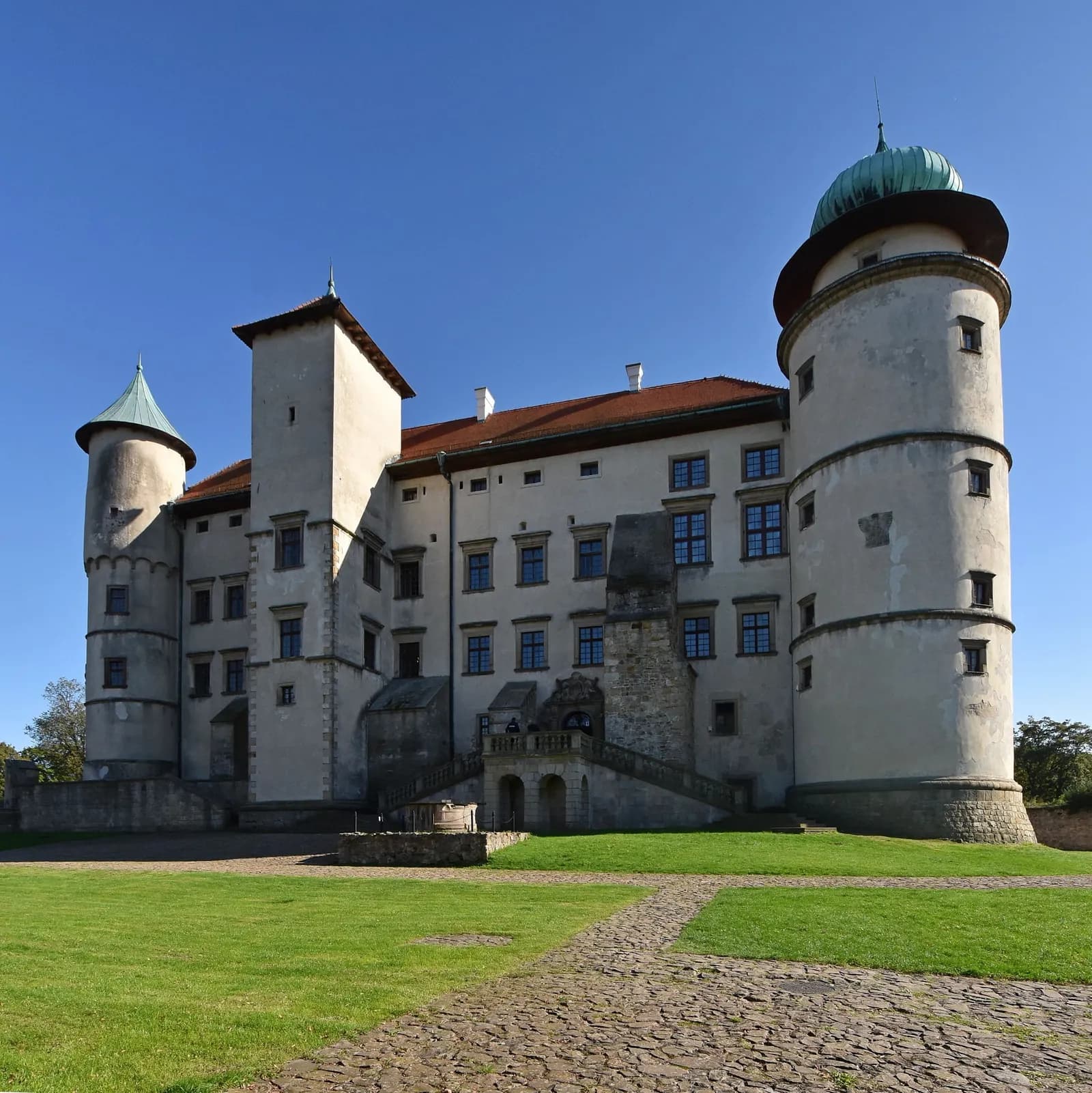
The castle at Wiśnicz stands on the northern side of a headland overlooking the valley of Leksandrówka. Its regular four-sided form, four towers and central courtyard reflect a history that stretches back to the 14th century, when the Kmita family began developing their properties around Wiśnicz.
The fortress initially served a practical purpose as a defensive stronghold for its owners. Its founder was Jan Kmita, who held the offices of governor of Sieradz, Russia and Krakow districts during the 1370s. The first documented reference to the castle, described as a castrum, appears in the records of the Bochnia salt mines from 1396.
The Kmita family remained associated with the residence until the death of Piotr Kmita, Governor of Krakow, in 1553. Ownership subsequently passed through the Barza and Stadnicki families before Sebastian Lubomirski acquired the castle in 1593.
For Wiśnicz, the arrival of the Lubomirskis marked a major transformation.
A residence rebuilt for a new age
Sebastian Lubomirski secured the title of Count of Wiśnicz from Emperor Rudolph II. His son, Stanisław, later undertook a substantial rebuilding of the castle between 1615 and 1621.
The medieval residence was strengthened with a five-sided bastion fortification designed by Maciej Trapola. The eastern side gained one of the complex's most distinctive features, a Baroque gateway shaped as a triumphal arch and completed in 1621.
Stanisław Lubomirski's influence extended beyond the castle itself. He founded the fortified Monastery of the Discalced Carmelites south of the residence and established Nowy Wiśnicz in 1616.
The Lubomirski family retained ownership until the middle of the 18th century. The estate then passed to the Sanguszko family and subsequently to the Potocki and Zamoyski families.
A fire in 1831 changed the castle's fortunes once again. Abandoned afterwards, it gradually fell into ruin. Its survival was eventually secured when the Union of the Family of Lubomirski repurchased the former estate and undertook renovation work.
After the Second World War, the castle was nationalised. A more thorough programme of renovation and reconstruction began in 1949 under the direction of Alfred Majewski.
Preserving the wider story of Wiśnicz
The castle is now closely connected with the Museum of the Wiśnicz Land, which has taken on responsibility for the historic residence as well as preserving the wider heritage of the area.
The museum itself occupies a building on the edge of the historic town, beside the road connecting the castle with the marketplace. Known originally as the Institution of the Poor, the building was founded by Stanisław Lubomirski in 1641 to assist poor and elderly people from the Wiśnicz region.
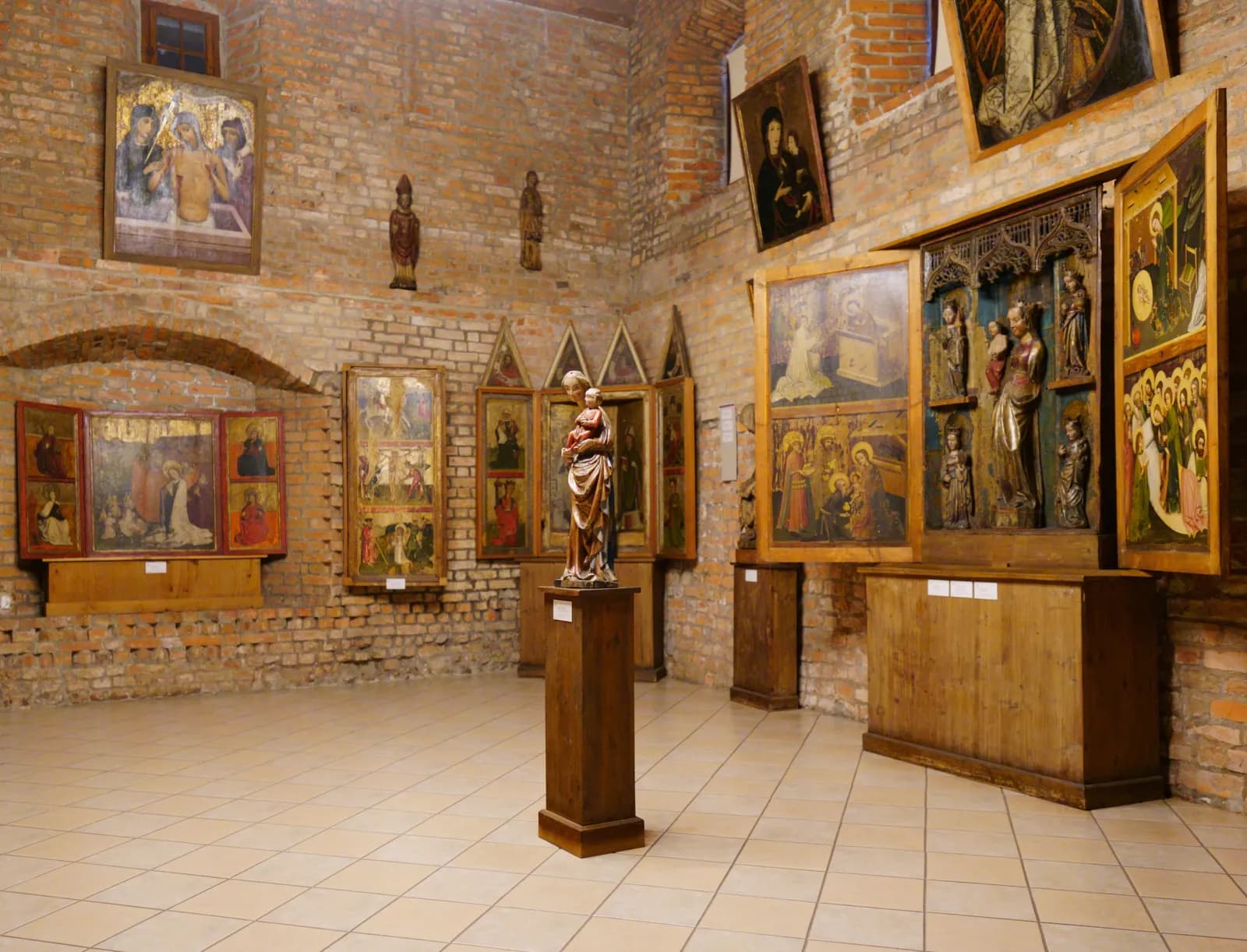
After the building was renovated, the Museum of the Wiśnicz Land opened there in 2002. Its collections document local history through objects including Second World War memorabilia, medals, books, historic documents and photographs. Among the more unusual exhibits are shackles from the prison in Wiśnicz and the only preserved uniform of a prison guard officer from before the Second World War.
One particularly valuable object is a 17th-century cannon barrel bearing the arms of Stanisław Lubomirski. It is the oldest of four surviving barrels once belonging to the Lubomirski family. The other three are held at Wawel Castle.
The museum also records the artistic history of the region, with works connected to artists from Nowy Wiśnicz including Stanisław Klimowski, Jan Stasiniewicz, Marian Rojek and Rev. Stanisław Nowak. Another chamber is dedicated to Professor Czesław Dźwigaj and includes designs for stained-glass works, the Elegies series of bas-reliefs, memorial medals and bronze miniatures from the Phantasmagorias series.
The collections also include personal gifts from Saint John Paul II: a calotte and rosary.
Since 2008, the Museum of the Wiśnicz Land has managed Wiśnicz Castle, bringing the history of the residence and the surrounding region into a single heritage story. Together with the Municipal Centre of Culture in Nowy Wiśnicz, it also organises events connected with the castle, town and region, including the “Holiday with ghosts”, which combines a history lesson with access to normally inaccessible castle undergrounds.
Wiśnicz therefore offers more than the remains of an impressive aristocratic residence. Its castle records centuries of architectural and political change, while the museum preserves the objects, people and stories that give the surrounding town its wider historical identity.
Visitor Information
Location: Castle in Wiśnicz and Museum of the Wiśnicz Land, Nowy Wiśnicz
Standard ticket: PLN 34
Reduced ticket: PLN 27
Opening hours: Monday–Friday, 08:00–18:00; Saturday–Sunday, 10:00–18:00